





Pavements
 Functional Pavements
  Saiga (pebbles)
   soft type
  W-Nature (pebbles)
   natural type
  W-Sand
   Soil Pavement
  W-Sports Sand
   Soil Pavement
  Freezing Protective
    Pavement
  W-Wood
   by use of chipped woods
  W-Rolled
   (Rolled Asphalt Pavement)
 Asphalt Pavement
 Concrete Pavement
 Semi-Flexible Pavement
 Functional Pavement
 Paving Materials
 Repair Materials
 Special Methods
 Recycling
Landscape Creation
 Saiga
  (natural pebble pavement)
 W-Wood
  (Wood Chips Pavements)
 W-Sand
  (Soil Pavement)
 CA-panax
   (colored Pavement)
 RP-pavement
   (semi-flexible pavement)
 W-Rolled
   (rolled asphalt pavement)
 Landscape Estimation
Pavements for Sports
 EXCELLENT Series
  SEMI-HARD
  HARD
 Soil Pavements
Building Construction
Laboratory
HomeAbout USHistoryOrganization
(in japanese)
IR Info(japanese)Contact us
Natural Colored Asphalt Mixture
W-Nature
What is W-Nature?
 It is natural colored hot mix asphalt mixture which is manufactured using natural pebbles, aesthetic crushed stones and sands as aggreate and using de-colorized asphalt as binder. Open grade mixtures width water permeability as well as dense graded mixtures with water impermeability are available.

Dense graded type for carriageway

Open graded type for foot paths
Features of W-Nature
  • Using de-colorized binder, the color of aggregates comes to appear to form a surface well harmonized with natural environment. Remarkable is that when put on service, the binder on surface of aggregates revealing the surface of natural aggregates and the surface get more natural appearance.
  • The methods of manufacturing and laying of this mixture are almost the same with ordinary asphalt mixture.
  • No dust is generated in fine weather.
  • The durability and skid resistance of this pavement is the same as ordinary asphalt pavement.
  • Using de-colorized binder that has propertied equal to modified asphalt, this pavement is applicable to heavy traffic carriageways.
    Where to use?
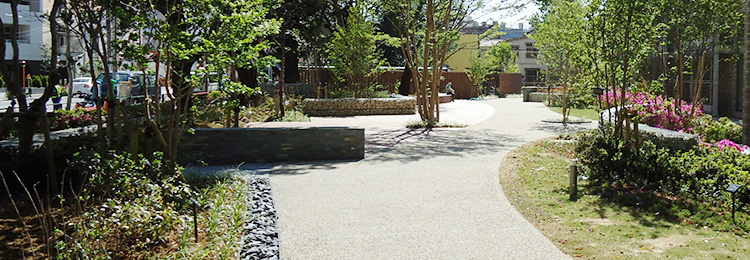
  • footpaths, park ways, promenade, 
  • squares in parks and events, gardens
  • precinct of and promenade to shrines, 
  • bicycle roads
  • roads around relic places and sight seeing places
  • lanes in residential areas

  • Typical Pavement Structure
    1) Footpaths2) Carriageways
      Class IClass II
    3-4cm
    10cm

    4-5cm

    15cm


    4-5cm
  • Classification of footpaths
    I  :footpaths and bicycle roads with no car traffic
    II:paths where cars with weight of less than 4 tons passes besides pedestrians and bicycles
  • The depths of binder course and base course in case of application to carriageways are determined depending on design CBR value and traffic volume.
  • In snowy area, a frost heave restraining layer is added.
  • For prime coat and tack coat, an emulsion of decolorized asphalt is used.
    Properties of Mixture
    1) Gradation
    Type of
    Mixture
    Gradation  (percent passing weight %)Remarks
    19mm13.2mm4.75mm2.36mm0.3mm0.075mm
    Dense graded100100-9580-5560-3525-1010-4The gradation ranges are in-company standards.
    Open graded100100-9552-2335-15--8-2

    2) Marshal Properties
    Type of MixtureDense gradedOpen gradedRemarks
    Standardactual valueStandardActual value
    Density    g/cm3---2.342---2.082
    Dense graded type was applied to carriageway and open graded type was applied to footpath actually. The standards are in-company standards.
    Stability   kN>=4.909.45>=3.433.77
    Flow value 1/100cm20-402420-4023
    Voids   %3-73.6---15.9
    AVFA*1 %---78.2---36.0
    Binder content %5.0-8.05.83.5-5.54.6
    permeability@cm/sec---------4.68 x 10-2
    *1:Aggregate Voids Filled with Asphalt

    Construction Dictionary
    (japanese)
    Japanese CultureLinks to Local Governmens
    (by prefecture)
    Links to Local Governmens
    (by sound)