





|
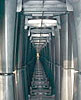
Developed as alternative for thin layer concrete pavement or semi-flexible pavement in tunnels, it is a durable bright colored hot mix asphalt mixture using white ceramic aggregates, white pigment and special binder. As special binder, epoxy-resin+de-colorized binder combination or modified de-colorized asphalt are used depending on traffic volume.
 |  Pavement surface | |
| 1 | : Using white ceramic aggregates, special binder, less abrasion by tire chain and long durability are actualized. Especially, using the combination of epoxy-resin and de-colorized binder, surface abrasion becomes one fifth of concrete pavement (a survey result on existing road). | | 2 | : Using white ceramic aggregates and white pigment, it shows excellent bright color. | | 3 | : The construction procedure is the same with ordinary asphalt pavement with no need of curing, thus construction period can be decreased. | | 4 | : No need of joints even on concrete slabs, thus enabling smooth ridability. | |
| 1 | : As surface course in tunnels (especially at problematic regarding abrasion by tire chains). | | 2 | : At where discrimination from ordinary traffic lanes is desirable (i.e. ramps of expressway, intersections). | |
| An Example of Construction | |
 | [Before] Rutting caused by rutting
 |  | [After] After milling up to the depth of rutting (5 cm), over laid by W-White.  | (1) W-White does not require cutter joint at matching the joint of existing concrete slab. (2) The gradation of W-White is the same as Stone Matrix Asphalt (SMA).Fig.-1 Typical pavement structure | |
| An Example of Aggregate Mix Design | |
Table-1 An example of mixture design for W-White unit:%Example No. | White ceramic #6 | Crushed Sone #6 | Crushed Stone #7 | Coarse Sand | Crushed Sand | Filler | White Pigment | Total | | 1 | 37.0 | 17.0 | --- | 38.0 | --- | 7.0 | 1.0 | 100 | | 2 | 25.0 | 46.0 | 6.0 | 5.0 | 5.0 | 12.0 | 1.0 | 100 | | standard | 25-40 | --- | --- | --- | --- | --- | 1-2 | --- | | #1: | At mixture design example 1, a combined binder of epoxy resin (35 %) and de-colorized binder (35 %) was used. | | #2: | At the mixture design example 2 modified and de-colorized binder was used. | | #3: | Plant fibre was added by the content of 0.3 % weight of Mixture weight. | | #4: | The content of white ceramic aggregate was decided considering the tendency of abrasion test. | |
| |
Table-2 Result of Marshal TestExample*1 No. | Binder content (%) | Density g/cm3 | Theoretical Density g/cm3 | Voids Content (%) | VMA*2 (%) | VFA*3 (%) | Stability*4 (kg) | Flow Value (1/100cm) | | 1 | 6.6 | 2.383 | 2.456 | 3.0 | 18.5 | 84.8 | 534 | 36 | | 2 | 6.2 | 2.366 | 2.438 | 3.0 | 17.5 | 82.5 | 690 | 28 | | *1 | The examples are the same with those in Table-1 | | *2 | percent Voids in Mineral Aggregates | | *3 | percent Voids Filled with Asphalt | | *4 | Stability is the value tested after 24 hours. | |
| |
| Abrasion Resistance and Rutting Resistance | |
Table-3 Test result of abrasion, rutting and crackingKind of pavement | W-White Thermo- hardening | W-White Modified type II | Thin layer concrete | Straight asphalt Dense Graded top size13 | Remarks | Abrasion resistance | Dynamic stability (passes/mm) | 0.47 | 0.68 | 1.95 | 4.98 | Ravelling test -10°CA270 minAcross-chain | Rutting resistance | Abrasion loss (cm2) | 42,000 | 6,650 | | 1,200 | Wheel tracking test 60°C, 6.4kgf/cm2 | | Regarding the test of Themo-Hardening type, tests were done after 10 days of curing. Regarding Thin layer concrete, the tests were done after 28 days of curing. | |
| |
| |